Thursday, April 12, 2012

Wade Poor for Asking for Olympic Pay


Some things don't have a price tag.  Pride and honor are two of them.  Dwyane Wade lacks both.

The Miami Heat All-Star and Olympic Gold Medalist is a great basketball player.  He will probably find his name in the National Basketball Association Hall-of-Fame one day.  But, Dwyane Wade is not a good American.  Maybe that is too harsh.  Dwyane Wade is an uninformed, arrogant, thoughtless American.

Wade recently stated that he thinks NBA players who compete in the Olympic games should be compensated for doing so.  He argues that after a long season, it's taxing for these world-class athletes to have to be back on the court, competing hard with very little rest for free.  Wade says playing in the Olympics is "not about the dollar, but it would be nice if you would get compensated."

Since when is having the privilege of being one of a select few people in the world, picked to represent the country with the greatest advantages in the world, not compensation enough? 

Wade will compete on a team this summer made up a players from all different backgrounds, whose combination of God-given talent and hard work have resulted in them earning a living that is dreamlike.  I don't blame them for that.  They have put themselves in a position to make that kind of money for their on-court play in the NBA and marketed themselves in a way to make even more in endorsements.  That is the American dream.

But, part of being a great American and living the American dream is understanding privilege and opportunity.  Dwyane Wade didn't grow up with a platinum spoon in his mouth.  He came from a humble background in Chicago and worked his way into worldwide icon status. Somewhere along that journey he lost perspective.

The Olympics represent one of the oldest, greatest, yet dying, aspects of our world, the opportunity to compete for the sake of competing.  The event was built on the concept of personal and national pride.  Have athletes cashed in on their Olympic performances after the games? Absolutely.  But, wanting money TO compete is a perversion.  It lessens the intent of what the Olympics are all about.

Not only are the five-multi colored rings about competing, they represent a chance for countries to highlight their successes and work together to try to improve the failures.

Dwyane Wade's comments point to the worldwide perception that Americans are greedy.

The world is consumed with financial problems.  European nations such as Greece and Portugal are swimming in a sea of debt.  Most of Africa defines wealth as the ability to get a healthy and full meal everyday.  Even thousands of Americans are still taking low paying jobs simply to keep food on the table. 

Yet, here is Wade, a multi-millionaire asking for more.  He made more than $25-million last year.  How much does he need?

Wade, along with his other superstar teammates in Miami, has a history of entitlement.  He is one of the biggest whiners in the league, held a preseason title celebration, only to lose in the Finals months later, and never shys away from moments to let the spotlight shine on his individual success.

There is no place for any of that in the Olympics.  That is a platform for selflessness and national pride.

Ask Tommie Smith and John Carlos. 

In the 1968 Olympics, the two men finished first (Smith, who also set a world record at the time) and third (Smith) in the 200 meter dash.  Both Smith and Carlos are African American and rose to Olympic prominence during the height of the civil rights movement. 

After accepting their medals on the podium in Mexico City, they each raised one clenched fist in the air.  At the time, many people thought it was to symbolize black power and defiance.  In fact, the U.S turned its back on them and both were kicked off the team because of the outrage. 

But, Smith and Carlos didn't apologize for their fists.  They displayed the gesture not for self promotion, but for national and international unity.   It was their way of denouncing racism and a symbol asking for all people coming together as one.  They used the Olympic stage to send this powerful message.

The image of Smith and Carlos with their fists raised high is iconic.  Their actions were selfless and helped push the nation's conversation of  racial equality forward.

Those men represent what the Olympics are all about.

Dwyane Wade needs to learn from their example.  The Olympics aren't about a petty paycheck.  They are about encouraging others to rise to the best in their profession.  They are about representing what is great about competition.  For American athletes, they are about being proud and honored to be a citizen of the most affluent and privileged nation in the world and representing it on the world's greatest stage.

Money is replaceable.  It can buy a lot, but it can't buy pride and respect, which are the foundations of the Olympic games.  Wade asking for more shows how poor he really is.

Thursday, April 5, 2012

Experimenting in College: A Start for the NCAA


To say college athletes don't value education would be disingenuous.  It's simply not true.  Every season there are great stories of those who play under the bright lights on campus while performing equally well, or even more impressively, in the classroom.  Kirk Cousins, Myron Rolle, and Robbie Hummel immediately come to mind.

But, it is fair to say that the concept of the student-athlete is broken.  Change is imperative.

Two stories over the past week reaffirmed my concern that young men are being used as financial pawns in the game of college athletics.

LSU safety and future NFL first round draft pick, Morris Claibrone, recently scored a four out of 50 on the NFL's standardized Wonderlic test.  A FOUR!

Claiborne is blessed with God-given talent and undoubtedly worked very hard to become one of the best players in the game, but at what cost?  The cost of a lack of education.

The Wonderlic isn't exactly the Bar Exam.  It isn't meant to identify a player as a genius, only competent.  Claiborne's abysmal low score is a testament to his and LSU's commitment to education.  It was non-existent.  Scoring a four basically indicates Claiborne either has a learning disability or has not been given the most BASIC tools to use his mind effectively anywhere but the football field.

Surely someone identified these problems in his three years at a Division 1 university.  He had tutors, coaches, and professors who must have noticed he struggled academically.  But, all obviously turned a blind eye because Claiborne had skill that translated to wins and subsequent revenue.

But, and I by no means hope this happens, but what if Claiborne blows out his knee in the preseason and can never play another down of football in his life.  Now what is left?  A young man is his early 20s with basically no educational foundation.  There are thousands of top notch college graduates who are sleeping in their parents basement because the jobs market is still brittle.  If Claiborne is without football and forced into a game where his mind is the primary muscle, he is not only not a star, heck, Claiborne isn't even in the arena.

He has all his eggs in one basket, football.  If they start to crack, he will be without a fallback option because he failed to take education seriously despite having a prime opportunity and those around him let him squander it because they were benefiting from his natural ability.

A disgrace.

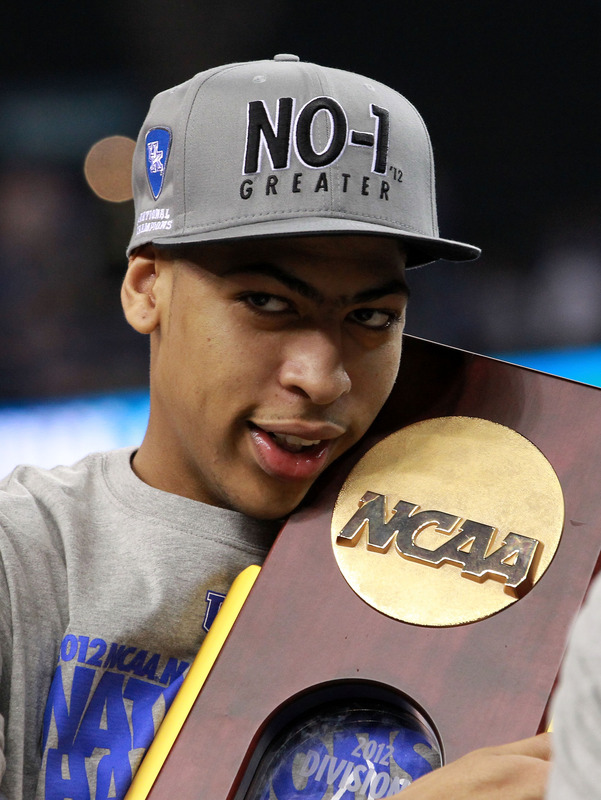
Monday night, I watched confetti fall, smiles shine bright, and trophies held high as Kentucky completed a dominating season in men's college basketball and claimed another National Championship in the school's storied history and first for head coach John Calipari.

The team, like others that Calipari took to Final Fours, was highlighted with standout freshmen.  Anthony Davis and Michael Kidd-Gilchrist both won't be able to legally drink alcohol for another three years, and even another year in Canada, yet they were responsible for not only carrying a team in front of a national audience, but also making their University, TV networks, and their coach endless amounts of money.

Both of these men will both be millionaires themselves shortly, and I have no reason to believe they don't take academics seriously.  But, they are puppets and the NCAA is pulling the strings.

Kentucky jerseys with Davis' number 23 could be seen in the stands throughout the tournament.  His famous/infamous unibrow was used as a marketing tool and what did he get? A nine month stay on Lexington's campus before jumping to the NBA.

I don't fault players like Davis and MKG for leaving after a year to make millions of dollars playing a game they have dedicated their life to, but college is an experience all students, athlete and other, should savor.  It's four years to grow and find yourself.

The NCAA makes BILLIONS, with a B, of dollars on the success of "student"-athletes.  There is plenty of cash to go around.  For an organization that prides itself on "EDUCATION" you would think the NCAA would do more to push that aspect and one way to do so is money.

Anthony Davis would probably go to the NBA after a year regardless, even if he was given an increased stipend.  He is physically and talent-wise ready for the pros.  But there are many who make the jump who aren't.  Michigan State's Marcus Taylor comes to mind.  He had a lot of college talent, but left too early for the money grab in the NBA.  He was drafted, but never hit it big.

If the NCAA increases the amount it pays to college student-athletes or reforms the rules for them to make money from their talent, it is more likely players like Taylor will stay on campus longer, develop their skill on the floor and in the classroom further, and be more well rounded when they GRADUATE.

The NCAA makes money on talents of those such as Davis, so why shouldn't Davis?  If he signs an autograph on a jersey with HIS number and sells it, Davis sits out for the season.  If the NCAA sells the same jersey, it pockets the money.  That seems unjust.

A physics student can make money doing research on cells and equations.  They have skills that translate to cash.  Davis and other athletes have their own set of skills, it's time to let them cash in while at the same time enjoying the benefits of college education.

I'm not asking for these players to make millions while on campus, but instead, a small percentage of the revenue generated from their sport or a scale set for what would be comparable to a part-time campus job.  That's fair.

I acknowledge this won't resolve all the problems in college sports.  But it's a start.  College is all about experimenting and learning, and things won't get better until the NCAA starts doing so.